Thursday, April 30, 2015

Muscle Testing for Allergies and Supplements


Last week I shared some basics about how to muscle test. Now here are a few more specifics that I hope will be helpful. 

Allergy testing - 

When testing for allergies, it's helpful to put a sample of the item you want to test in a glass jar (with a lid if it's something you're very reactive to). Then hold the jar and test, "Am I allergic to this ___?" I usually also test, "Am I sensitive to this ___?" Often I may not have a genuine allergy to the item, but my body is sensitive to it. 

You can also test for combination allergies. For example: "Am I allergic to the combination of this egg and the pollen in the air?" I often have combination allergies, so sometimes I'll test not allergic to individual substances, but when I check them in combination I find the allergy. 

When you're having an allergic reaction but you don't know to what, you can muscle test to help figure it out. We usually start by testing a few basic things: 
"Am I reacting to something I ate?" 
"Am I reacting to something in this room (or outside, or whatever environment you're in)?" 
"Am I reacting to something I was exposed to in ___?" (If you were out shopping and felt worse when you got home, you might be reacting to something you encountered such as perfume, mercury, pesticide, etc.)
Usually we can keep testing until we pinpoint the specific cause of the reaction, then we either remove the item or try to clear the allergy (see note below). 

Also, when you start to have an allergic reaction, it's really helpful to take some Tri-salts immediately. That will neutralize the reaction and hopefully keep it from getting worse. I carry Tri-salts in my purse so it's always handy. 


Testing supplements -

When testing supplements, we always start with checking for an allergy. "Am I allergic to this pill/capsule/etc.?" Then we usually test " Am I sensitive to this ___? And often we also check, "Am I allergic to one of the ingredients in this ___? ...sensitive to one of the ingredients?" We do this because if you try to test the dose of a supplement that you're allergic or sensitive to, you won't get an accurate test.

Once you know you're not allergic or sensitive to the supplement, then you can test the dose. First make sure it's something good for your body by testing, "Would it be good for my body to take this ___?" If yes, then test, "Would it be good for my body to take more than one today?" 
It's important to use this "more than..." phrasing, because that gives you the most accurate and specific information of how much to take.
For example: Would it be good for my body to take more than 5 vitamin C capsules today?" If the test is "yes," then you would ask, "...to take more than 6 today?" If the test is "no," then you know the best dose is 6 for today. 

Some of my supplements test pretty much the same dose all the time. Other ones seem to vary. Sometimes I need 7 caps a day. Other times only 5 a day. What the body needs will change from day to day and week to week. That's one of the reasons muscle testing is so helpful, so you can know what is good for your body right now. 

It's also helpful to test when is the best time of day to take a supplement. Believe it or not, this does make a difference. My mom almost always tests to take her potassium in the evening. If she tests it in the morning, it'll test not to take it. So you can test "Would it be good for my body to take this ___ right now?" Or "...with lunch? ...with supper? ...between meals?" etc. Certain supplements if I take them after 6pm will cause problems, such as allergic reactions before bed, difficulty sleeping, etc. 

Certain supplements sometimes are better taken together, other times taken apart. (I usually take my magnesium and calcium at different times in the day, though occasionally we test I should take them together.) Your brain knows what is best for your body in the moment.

Now, obviously you don't want to spend your whole day muscle testing stuff. =) I understand. These are just some tips we've learned that hopefully will help you take care of your body the best way you can. 

There are many other uses of muscle testing, such as locating parasites, viruses, candida, etc., identifying deficiencies, determining which treatments are most helpful, etc. But I think this is enough info for one post. =) 

Do you have any questions? Is this info helpful? I always appreciate your feedback. =) 


Note: A quick and easy way to clear allergies and sensitivities is something we learned from Dr. Smith who developed the CBT method. 
While holding the item in your hand, place the back of your hand (or have someone else do it with their hand) on the top of your head for 5 seconds. This basically tells the brain that the substance is ok and it doesn't need to react to it anymore. Usually, just doing this once will clear the allergy. But it's ok to repeat it again later if needed.

Thursday, April 23, 2015

How To Muscle Test


I've mentioned muscle testing in posts before, and I promised to write more information about it. So for those who are interested, I'll give some basic instructions. I may write another post later about why I believe this is such a valuable tool, but for now let's look at how to use it.

Basically muscle testing is a way to use the muscles to glean information about the body. Your brain knows everything that happens in your body, with all that information stored on the non-conscious level. Muscle testing helps you access specific information you need to know on the conscious level. By applying pressure to a specific muscle, the response of that muscle will be either "weak" or "strong," indicating what is good or true for the body.

That's probably not the best explanation of what muscle testing is or how it works, but hopefully it'll make more sense as I continue.

There are several different ways to muscle test. You can use an arm test (holding your arm straight out and applying slight pressure to test). There are also different finger tests you can use. The simplest method we've found is to use a standing test and to ask very specific yes/no questions. 

Standing Test: 
Stand up straight. Ask a yes/no question. In response, your body will either lean forward or backward. Leaning forward is a "yes" answer. Leaning backward is a "no" answer. 

A good way to start to practice using the standing test is to simply state, "My name is ___" and insert your name. Your body should lean forward, as a "yes" answer. Then say, "My name is Bob" (or any name besides yours), and your body should lean backward, a "no" answer. 

With the standing test, you should get a pretty strong pull forward or backward, but even if it's just slightly leaning one way or the other, that's probably still a good test.

Since muscle testing does require some energy, I've found that I can usually only test myself on my really good days. Most of the time my mom is my "surrogate" tester. She touches my arm (needs to be skin-to-skin contact) then she asks the questions for me and does the standing test. 

Example: She might say, "Is Joanna allergic to this apple?" (When testing for food allergies it helps if you can put a sample of the food in a glass jar and hold it in your hand while testing.) Then if she leans backward, we know it's a "no" answer, I'm not allergic to the item. 

Most people are able to test themselves, with a little practice. If you aren't able to, maybe you can ask someone to help by doing the surrogate testing for you.

When doing the testing, keep your brain clear of other thoughts. If you're thinking about something else or worrying about the test, it usually won't work. Sometimes when we we test something and get an answer that I'm pretty sure is wrong, I look at mom and she laughs and says, "Sorry I was thinking about something else." So just try to stay relaxed and only thinking about what you're testing. 

At first you might find the muscle testing awkward or unclear, but as you practice a little, you'll get the hang of it. Once you get a clear response doing a test (leaning forward or backward), then you know what it feels like and it gets easier. 

A lot of doctors use the arm test, where you hold out your arm and have someone gently push on it to get a "weak" or "strong" response. Personally, I find this method harder to do and less clear in its results. Also your arm can get tired quickly. 

Lately we've been using a finger test sometimes, which is more convenient since you can't always stop what you're doing and stand up to test yourself. Here's a short video that explains this simple finger test. 

Some other tips to remember about muscle testing - make sure you're hydrated when testing, or results may be inaccurate. Don't have a cell phone in your pocket, as that can interfere with the testing. Don't stand right next to appliances, computers, or other electronic devices when testing. 

Once you get the hang of how to test yourself, you can test various things - such as allergies, use of supplements, problem areas in the body, toxicity, parasites, etc. Basically anything that the brain knows, you can do a muscle test for. Just make sure you're using very specific yes/no questions, otherwise the body may not respond with an accurate test. (Learning what kinds of questions to use also takes some practice. I'll try to share more on that next week.) 

Muscle testing does take some practice and some trial and error, but we've found it to be an extremely valuable tool. Next week I'll share some specifics on how to use it for allergies, supplements, etc. 

Any questions?

Thursday, April 16, 2015

My Experience With Reflexology


I'd heard of reflexology a few times over the last ten years, but I hadn't tried it until recently. And I'm very glad I finally tried it! 

The basic theory behind reflexology is that there are reflex points on the hands and feet that correspond to the different areas of the body. By working on the feet and/or hands, you can stimulate various organs, glands, etc.

The reflexologist I went to said that the main goals of reflexology are to reduce stress and to improve circulation. In fact, having a reflexology session is in some ways similar to having a full body massage. This enables the body to function better and heal more effectively.

There's a lot more I could explain about reflexology, but instead I want to share my experience with it.

In my first session, the therapist was careful to work very gently on my feet. I had told her a little of my health history and that I still have ongoing challenges. She could tell simply from feeling my feet that I have some chronic issues. She worked very gently and for only about 10 minutes on each foot. That was enough for the first session. I was very thirsty afterward, and she told me to drink a lot because my body would be detoxing. The next day I noticed that I felt a tiny bit better, so that was encouraging. 

During the second session, she was able to work my feet longer, about 15 minutes on each foot. The most tender part was the ball of my foot. I asked which area of the body that corresponded to and she said the lung/chest area. That made sense because I'd been having more trouble breathing lately. After the second session, I noticed I felt a little better for the next two days. 

In the third session, she worked my feet a little harder and a little longer, but it felt good. After that session, I had three really good days! I actually woke up by 8am, my brain was clearer and I had more energy. It was wonderful! =) 

By the time the fourth session came, my feet were telling me they wanted more reflexology! =) During the fourth session, she worked my feet quite hard. For the most part it felt good, but I could tell about half way through that the toxins were really flowing in my body. I think I let her work my feet too long and too hard, because after the fourth session, I had about 10 days of major detoxing. In the long run I'm sure it was a good thing, but it wasn't pleasant in the process. It probably would have been better to not have her work my feet quite so hard, and let my body do the detoxing a little slower. 

So that's how the first four sessions went for me. Now that I'm mostly through that detoxing cycle, I'll probably go back for some more reflexology. Only this time I'll be more aware of when to stop the session. 

The therapist who helped me said for anyone with chronic issues, she recommends two sessions a week for 4-6 weeks. After that, she usually reduces it to once a week, and then as needed. She said it varies from person to person, what they need. For me, she was addressing the whole-body chronic issues I have, so more sessions and more frequent is better. For others, they may just need help with a specific area like a weak gut, or a shoulder injury, etc. Reflexology can help with pain from injuries and such. My therapist was able to help her husband avoid knee surgery through doing reflexology on him. 

She also said that prices for sessions can vary from $30-60 depending on who you go to. 

There are several reflexology charts available online, though they vary somewhat in specifics. While you can learn from these, it's still best to have a certified therapist help you address any ongoing health challenges.

For more information about reflexology or to find a certified therapist in your area, you can check out this website: 

Well, that's all for now. If you have any questions or want to share your experience with reflexology, you can post a comment here. 


Other articles about reflexology:


Thursday, April 9, 2015

A Good Resource


Just a quick post today as I've been having some adrenal symptoms from detoxing this week and need to rest a lot. 

I wanted to share this great website which includes access to an online magazine, tv episodes, a blog, and more. It's all about health, knowing the cause of health problems, what you can do for your health, healthy recipes, etc. 

Check it out and let me know what you think. =) 


Thursday, April 2, 2015

Thankful


Lately the reality and abundance of toxins, mold, chemicals, etc. has been pretty overwhelming for me. Sometimes I feel like I belong in a different century when life was simpler and healthier. 

I keep asking God to teach me how to live in this crazy, toxic world of today. I know God chose to place me in this time in history. I know He has a plan and purpose for me here and now. So I can only trust that He will teach me how to do more than exist, how to live healthily, even how to thrive, overcoming the obstacles day by day to accomplish the good things He wants me to do. 

I think that an important part of this process is to continually be thankful. Instead of dwelling on all the challenges, I need to take time to give thanks for the gifts and blessings that pour over me. 

With Easter coming this weekend, I'm reminded that ultimately my life is in heaven. That is my home. That is my destiny. That is my glorious future!

Which means that I can live life here free from fear, full of joy, and empowered to bless others. 

I truly have MUCH to be thankful for! 

Whatever challenges you're facing right now, will you join me today for a few minutes in giving thanks? I'll help you out by listing some things I'm thankful for that maybe you can give thanks for as well. =) 

If you have a bed to sleep on and a pillow for your head - give thanks.
If you have water to drink - give thanks.
If you have windows to look out and see the sky, sun, clouds, trees, birds, etc. - give thanks. 
If you have shoes on your feet - give thanks.
If you can still smile - give thanks. =) 
If you have food in your fridge - give thanks.
If you have someone to laugh with - give thanks.
If you have a Bible in your own language to read whenever you want - give thanks.
If you know Jesus is always with you no matter what - give thanks! 

Yes, I am thankful! Here and now, come what may. I am thankful. 

Thursday, March 26, 2015

A Little EI Humor


One of the most important things to hold onto in trials is a sense of humor. Most of the EI people I meet who are handling their challenges better than others, are the ones who can still laugh about things. 

So here's a little EI humor for you today. =)

If there was a book of EI World Records, here are some possible categories it might have:

- number of states and/or countries you've grounded in

- total number of nights spent sleeping somewhere not in a house (i.e. in a tent, vehicle, porch swing, etc.).

- number of doctors visited (my count is somewhere over 40, but I know for some people it's 80+)

- number of consecutive weeks spent without eating any wheat, dairy, corn or soy products

- total number of doctor/treatment recommendations you've received from family, friends and helpful strangers

- number of supplements taken in a one week period (I think my friend K holds this record)

- number of years since you ate pizza two days in a row

- number of health books you've read

- number of strangers who've asked you in the store, "What are you going to do with all that vinegar?"

- number of loads of laundry (including soaking and extra rinses) done in a one week period (My mom holds this record for sure!)

- number of different health food stores you've visited (my list includes stores in at least 5 states)

- number of people who have helped you, prayed for you, encouraged you, and blessed you on your journey (love to see some great competition for this one!) =) 


What categories would you add? 


Yes, this EI life can be pretty crazy. The good news is that these aren't the kinds of records that really matter. What matters is - 

- the number of times we give thanks 

- the valuable lessons we learn

- the special people we meet on the journey

- the gifts of compassion and understanding we give to others 

- the positive choices we make again and again and again...


So don't worry about getting in any record books. =) Just keep being you. Keep laughing. Keep loving. Keep living - even when life is crazy. 

Blessings,
-Joanna

Thursday, March 19, 2015

Some Basic Anatomy

About 12 years ago a doctor told me I had adrenal fatigue (which later became adrenal insufficiency). At the time, I knew the adrenal gland was responsible for producing adrenalin. Otherwise I was pretty clueless. It was actually only a few years ago that I learned I had two adrenal glands! For years I thought there was just one, on the right side of the body. I was embarrassed when I realized there's one on the left side of the body as well. 

Through the years I've had to learn a lot about the body. And I'm still learning. Just last week my mom mentioned maybe there was a problem with my adenoids. I laughed and said I didn't even know I had adenoids! =) 

Today I want to share some basic anatomy info. I'm definitely not an expert. In fact, what I don't know about anatomy is probably more than I do know about it. But I think a basic understanding can be helpful, especially when visiting doctors or trying new health treatments. 

So stay with me, and maybe you'll learn something. (Or feel free to correct me if I make a mistake.) =) Also, I looked for very simple charts to share here, ones that are uncluttered and easy to read. I hope they're helpful. Just keep in mind that this is basic info, not an extensive description. 

Internal organs - The chart below shows the basic internal organs. 

- heart is more or less in the middle with lungs on either side
- liver is on the right side, toward the back
- spleen is on the left side (kind of under the rib cage)
- stomach is above the belly button
- pancreas is mostly in the middle
- gallbladder is near the liver on the right side
- kidneys are on both sides, in the back
- appendix is on the right side, lower down
- large and small intestine look a little complicated, but food moves from the stomach into the small intestine, then into the large intestine, which follows a direction starting on the right side, going up and over and down on the left side.

Endocrine system - This chart shows the glands in the endocrine system.

- pineal gland, pituitary gland, and hypothalamus are located in the brain
- thyroid and parathyroid are on the sides of the neck, toward the back
- thymus gland is more or less in the middle of the chest 
- adrenal glands are on the right and left sides (they look a little high to me in this chart, but I could be wrong).


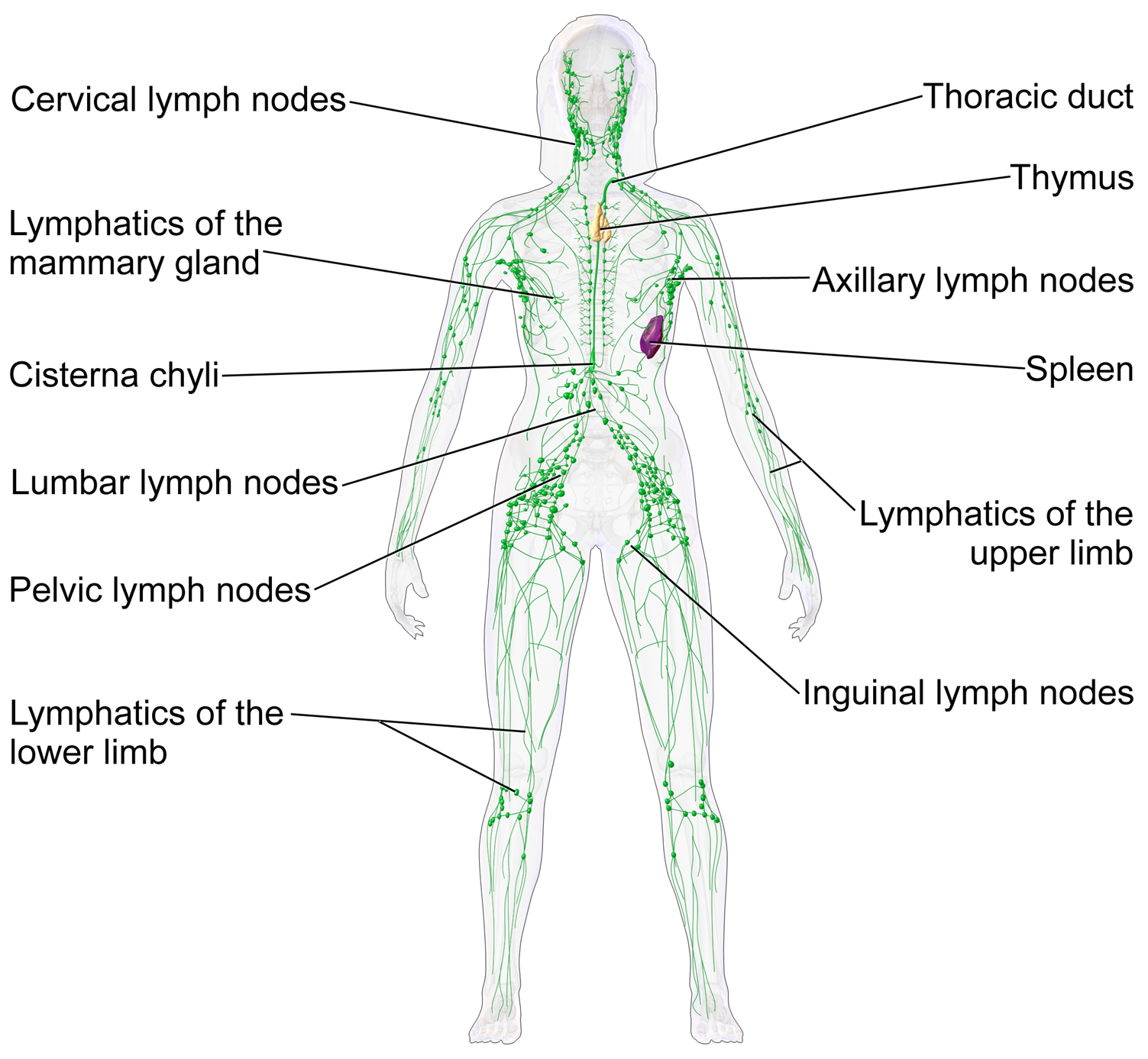
Lymphatic system - The lymphatic system is the body's natural detox system, made up of lymph nodes and vessels throughout the body. The lymph fluid doesn't have a 'heart' to pump it, so it relies on the motions of muscle and joint pumps. This is why regular lymphatic massage is so important. 

Obviously, we could also talk about the bones, spine, muscles, tissues, etc. But I think this is enough for one post. =) 

Just remember that everything in the body is connected and works together. For example, at my last physical therapy appointment, I was having a little difficulty breathing. My physical therapist said the left lung seemed to be the problem. But first she started working on the area of my large intestine, on the right side of my body. Gradually she worked up and across my torso, then she worked on my neck and shoulders. At the end of my appointment my left lung was much improved and I was breathing better. And I was very thankful for a wonderful physical therapist who understands how everything in the body is connected. 

P.S. In case you're still wondering, the adenoids are near the tonsils. I'm still not sure what they do, but maybe I'll find out and tell you in another post sometime. =)